

Smokers are told “no” more often than the evidence actually supports. Smoking does raise implant failure risk that part is well established but it isn’t an automatic disqualification for most patients. The real answer depends on how much someone smokes, whether they’re willing to pause around surgery, and what the rest of their oral health looks like.
Yes, smokers can get dental implants, but the failure risk is meaningfully higher than for non-smokers. A 2024 systematic review of nearly 60,000 implants found smokers had a 159% higher risk of early implant failure. Quitting or pausing smoking around the surgical and healing period substantially improves the odds, and many dentists will proceed with informed consent even without full cessation.
What the Evidence Actually Shows
A 2024 systematic review and meta-analysis covering 32 clinical studies and 59,246 implants found that smokers had an odds ratio of 2.59 for early implant failure compared with non-smokers meaning the odds of early failure were 159% higher in smokers (ScienceDirect, 2024). The risk was even more pronounced in the upper jaw, where implants in smokers failed at nearly six times the rate of non-smokers in some included studies, compared with under four times in the lower jaw.
A separate, broader umbrella review of 17 systematic reviews reached the same directional conclusion using a different methodology: the overall strength of evidence points to a lower rate of successful osseointegration and a higher rate of implant failure specifically attributable to smoking, independent of other risk factors (PMC, 2024).
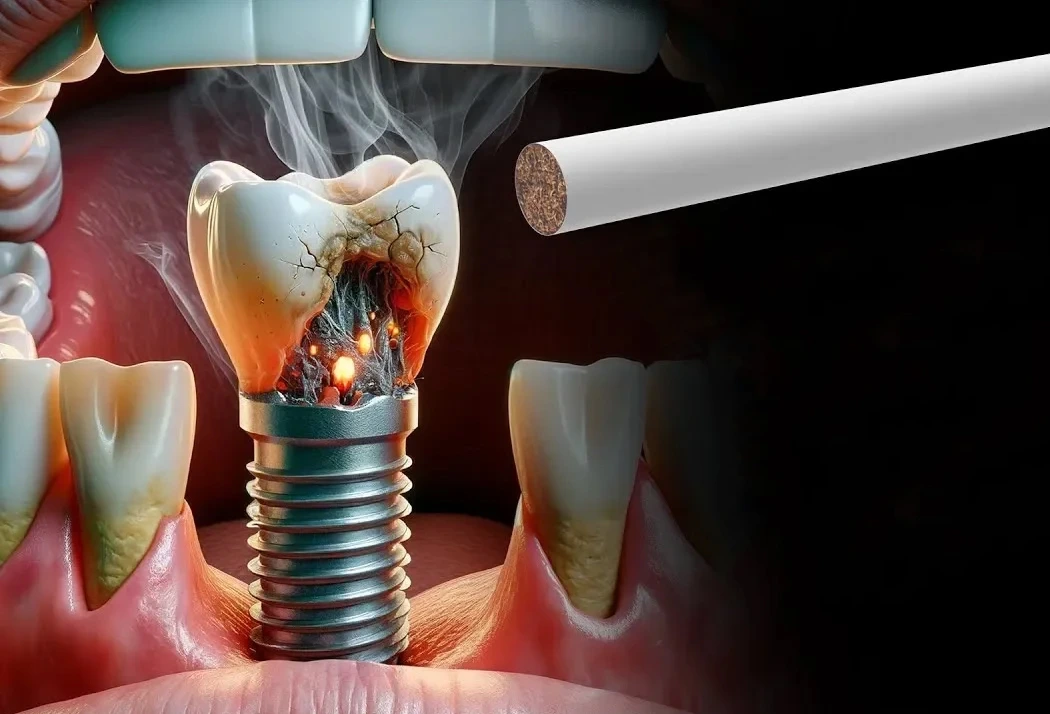
The mechanism is well understood: nicotine constricts blood vessels and carbon monoxide reduces oxygen delivery to healing tissue, both of which directly interfere with osseointegration, the process where bone fuses to the implant. Reduced blood flow means slower, weaker bone formation around the implant during exactly the window when it matters most. This is also why the effect is dose-dependent rather than a fixed penalty applied to anyone who smokes at all.
Dose Matters It’s Not All-or-Nothing
A separate meta-analysis published in Evidence-Based Dentistry found a clear dose-response relationship: patients smoking under 10 cigarettes a day had a measurably higher failure rate than non-smokers, and patients smoking more than 10 cigarettes a day had a significantly higher failure rate again than lighter smokers (Nature/EBD, 2021). In practical terms, this means the risk of conversation with a smoker isn’t binary. A two-cigarette-a-day patient and a pack-a-day patient are not the same case, and treatment planning should reflect that rather than applying one blanket answer to every smoking patient.
Where Smokers Are Genuinely at Higher Risk
- Early failure, during the first weeks to months after placement, when osseointegration is most vulnerable to reduced blood flow
- Upper jaw placements, where bone is naturally softer and the impact of impaired healing is more pronounced
- Peri-implantitis later in life gum inflammation and bone loss around an otherwise successfully integrated implant, which smoking also elevates the risk of long after the original surgery, not just during initial healing
- Delayed soft-tissue healing immediately after surgery, which can extend discomfort and increase infection risk
- Marginal bone loss over time, even in implants that integrate successfully smoking has been associated with measurably greater bone loss around the implant compared to non-smokers over years of follow-up
What Actually Improves the Odds for a Smoking Patient
- Pausing around surgery. Even a temporary break commonly recommended as at least one week before and two weeks after placement reduces the acute impact of nicotine and carbon monoxide on the critical early healing window, though evidence on the exact optimal duration varies by study.
- Full cessation before treatment, where realistic. This is the single change with the largest measured effect on long-term success, and it’s worth raising with your physician if you’d like structured support, not just willpower alone.
- Impeccable oral hygiene, which matters more for smokers because their baseline gum and bone healing capacity is already reduced, see our full guide on keeping a dental implant clean and hygienic for the specific daily routine that matters most.
- Choosing implant sites and timing carefully. A dentist may recommend the lower jaw over the upper jaw where clinically appropriate, or delay placement until any active gum disease is treated first.
- More frequent post-placement reviews, so early signs of poor integration are caught and managed before they become failure. This is a standard, sensible adjustment to the normal implant healing timeline for a smoking patient, not a sign anything is going wrong.
Nicotine Replacement, Vapes and Chewing Tobacco: Where the Evidence Is Thinner
Patients frequently assume switching to a nicotine patch, gum, or vape sidesteps the implant risk conversation entirely; the evidence doesn’t clearly support that assumption. Nicotine itself, independent of the combustion products in a cigarette, is understood to constrict blood vessels, which is the primary mechanism affecting bone healing. This means nicotine replacement products likely carry some reduced version of the same risk, though dedicated implant-specific research isolating nicotine alone from smoking is still limited. Smokeless and chewing tobacco carry their own distinct oral health risks (including direct effects on gum tissue) separate from the implant-healing question, and shouldn’t be assumed a safer substitute during the healing period.
Does Smoking Affect Every Stage, or Mainly the Beginning?
A common misconception is that smoking’s impact is limited to the initial healing window and stops mattering once osseointegration is confirmed. The evidence doesn’t support that. While the acute risk is highest during the first weeks after placement when osseointegration is most vulnerable to reduced blood flow, smoking continues to elevate risk across the implant’s entire lifespan through a second, separate mechanism: ongoing susceptibility to peri-implantitis. This is why the smoking conversation with your dentist isn’t a one-time pre-surgery checkbox; it’s relevant at every stage from the first consultation through years of ownership, and it’s covered in more depth in our guide to dental implant longevity.
What a Smoking Patient’s Consultation Actually Covers
Expect this to be a more detailed conversation than a simple yes/no on smoking status:
- How much and how often you smoke, since the dose-response relationship means a light smoker and a heavy smoker are genuinely different cases, not variations of the same risk category.
- Your willingness and timeline for pausing around surgery, discussed honestly rather than assumed some patients can realistically commit to a two-week pause; others cannot, and treatment planning should reflect the real answer, not the hoped-for one.
- Your gum health specifically, since active gum disease combined with smoking compounds risk in a way that’s worth addressing before implant surgery regardless of smoking status alone.
- A realistic discussion of implant site choice, since lower-jaw placement carries a comparatively lower relative risk for smokers than upper-jaw placement where clinically appropriate.
A Realistic Scenario
Consider a patient, Rohit, 41, smoking about 8 cigarettes a day, needing a single implant to replace a lower molar lost two years ago. His bone volume is adequate, he has no diabetes, and his gums are healthy. In this profile, most implantologists would proceed recommending he pause smoking for at least a week before and two weeks after surgery, placing the implant in the denser lower jaw, and scheduling closer follow-up checks during the first three months. His individual risk is elevated compared with a non-smoker, but it isn’t prohibitive. A heavier smoker with additional risk factors uncontrolled diabetes, active gum disease, upper jaw placement would face a materially different, more cautious conversation, and might reasonably be advised to address gum disease and reduce smoking meaningfully before scheduling surgery at all.
When an Implant Might Genuinely Be Delayed or Declined
- Active, untreated periodontal (gum) disease alongside heavy smoking
- Very heavy smoking (commonly defined in research as 10+ cigarettes/day) combined with other risk factors like uncontrolled diabetes
- A patient unwilling to accept any modification to smoking habits even temporarily, combined with poor existing bone quality
In these situations, a dentist may recommend treating the underlying gum disease first, exploring a shorter pause in smoking as a minimum condition, or considering a bridge or denture as an interim or alternative option instead, at least until conditions improve enough to revisit implants.
FREQUENTLY ASKED QUESTIONS
Not necessarily many dentists proceed with a temporary pause around surgery and healing, though permanent cessation gives the best long-term odds and lowers ongoing risk of peri-implantitis.
A commonly recommended minimum is one week before and two weeks after placement, covering the most vulnerable part of early healing, though your dentist may recommend longer based on your case.
Research specifically isolating e-cigarettes from traditional smoking is still limited; most reviews note this as an area needing more study rather than a settled answer, so it shouldn’t be assumed safer for implant healing.
No research consistently shows a higher relative failure rate in the upper jaw than the lower jaw for smokers, because the upper jaw bone is naturally less dense.
Most won’t refuse outright, but expect a frank risk conversation, possibly a recommendation to pause smoking, and closer monitoring during healing than a non-smoking patient would need.
Yes, recent quitting still helps, since the mechanism (reduced blood flow and oxygen during healing) is tied to current, not historical, smoking status.
Not clearly nicotine itself constricts blood vessels regardless of delivery method, so replacement products likely carry some reduced version of the same risk rather than eliminating it, though this specific comparison hasn’t been extensively studied in implant patients.
Less than current status does. The mechanisms affecting healing are tied to active nicotine and carbon monoxide exposure, so a patient who has genuinely quit is assessed closer to a non-smoker than someone still smoking, though any existing bone or gum changes from years of smoking are evaluated separately during your CT scan and exam.
Author